Vandergriff endorses the message and work of Matt Larsen in using Combatives for culture change!
Matt's work on Combatives is incredible, but it is more than just hand to hand proficiency, it means building confident and adaptive Soldiers that can deal with 4th Generation Warfare problems.

Donald Vandergriff Preface:
Matt Larsen’s article, Lessons Learned from the Battlefield: “Live” Training Pays Off, is a powerful testament to the principles of adaptability, resilience, and practical training that lie at the heart of the military reform efforts championed by myself and William S. Lind. Our work has long emphasized the transition from the rigid, centralized culture of 2nd Generation Warfare to the decentralized, initiative-driven ethos of 3rd Generation Warfare, which is essential for prevailing in the complex and unpredictable environment of 4th Generation Warfare. Larsen’s insights into close quarters fighting and combatives align seamlessly with these ideas, particularly through the application of Outcomes-Based Learning (OBL) methodology to implement Mission Command and Maneuver Warfare.
Larsen’s vivid account of a Soldier employing a kimura arm lock to subdue a resistant suspect at a Baghdad checkpoint illustrates the real-world impact of training that prioritizes adaptability over rote memorization. This is precisely what OBL seeks to achieve: fostering decision-making and problem-solving skills under pressure, rather than relying solely on prescribed Techniques, Tactics, and Procedures (TTPs). By training Soldiers to fight against fully resistant opponents in realistic scenarios, Larsen’s approach mirrors the OBL framework, which empowers individuals to think critically and act decisively in chaotic situations—a cornerstone of Mission Command.
Moreover, Larsen’s emphasis on “live” training reflects the cultural shift required to move the Department of War toward a 3rd Generation Warfare mindset. In a 2nd Generation culture, the focus is on process and compliance, often stifling initiative. In contrast, Larsen’s combatives program cultivates fighters who can operate effectively in the fluid, decentralized battlespace of 4th Generation Warfare, where adversaries exploit unpredictability and asymmetry. By integrating combatives into daily physical training and tactical scenarios, Larsen ensures that Soldiers are not just technically proficient but also mentally prepared to handle the ambiguity and physicality of modern conflicts.
This article underscores the necessity of training that bridges the gap between theory and execution. Larsen’s focus on building fundamental skills without kit, then progressively incorporating equipment, ensures that Soldiers can adapt their techniques to real-world conditions without losing effectiveness. This pragmatic approach aligns with Maneuver Warfare’s emphasis on agility, initiative, and exploiting opportunities in the moment. By making combatives a unit norm, Larsen is helping to forge a military culture that values fighters over checklists—a critical step in preparing our forces to win in the evolving landscape of warfare.
Begin Matt’s Article:
Lessons Learned from the Battlefield: “Live” Training Pays Off
Memorizing TTPs won’t save you; fighting under resistance will.
Sep 25
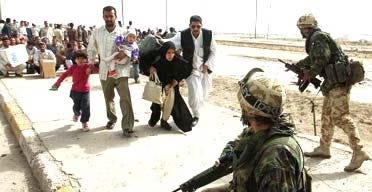
Baghdad Checkpoint
The gunner let loose a long burst of machine-gun fire through the windshield of a speeding car. Days earlier, two Rangers had been killed nearby when a “pregnant” woman detonated a suicide vest at a checkpoint. No one was taking chances.
This Substack is reader-supported. To receive new posts and support my work, consider becoming a free or paid subscriber.
The driver kept coming. He rammed the metal guardrail the Rangers had turned into a makeshift defensive position. The sedan hit with tremendous force, flipped over the Soldiers’ heads, and landed upside down behind them in a billow of dust, wheels still spinning.
The machine-gun team stayed in place to cover the intersection. Three more Soldiers moved to the overturned car. Seeing muzzles pointed at their faces, the three men inside raised their hands and clumsily poured out the window. Once they were on their feet, the Soldiers began searching them and tying their hands behind their backs.
One Soldier had his rifle on an assault sling so he could use both hands. He was counting on his teammate’s cover. As he started to search the third man, the suspect got unruly and tried to get his hands on the slung rifle.
Not wanting to shoot what he thought was an unarmed man, the Soldier drove hard into him, pinning him against the wreck. The suspect still fought for the weapon. The Soldier clamped the wrist, fed his own hand over, and locked the figure-four —a reverse bent arm bar, or kimura, exactly as he’d done a thousand times on the mat.
“The added weight of my body armor and equipment only made it that much easier to break his arm,” the Soldier said later.
Once the enemy was subdued, a pistol was found hidden in his clothing, and three AK-47s were in the car.
Lessons Learned
Combatives is for every Soldier. Traffic control points, detainee searches, CQB, any Soldier can be in a hands-on fight with almost no warning.
“Live” training pays off. He could execute a kimura in real time because he had done it against fully resistant partners, not walk-throughs, not just drills.
Equipment doesn’t change the fight’s fundamentals. Body armor, helmets, and kit change leverage and fatigue, but the positions and finishes are virtually the same.
TTPs (Techniques, Tactics, and Procedures) don’t win fights; fighters do. Memorizing search procedures, cuffing methods, and other TTPs can put you in an advantageous position when a fight starts, but unless you can actually fight under resistance, position alone won’t win the struggle.
Train as You Fight—But Don’t Let Kit Kill the Training
It’s tempting to keep full kit on all the time in the name of realism. The problem: injury risk goes up, intensity comes down. With plates, mags, radios, weapon lights, and NVG mounts, the danger is obvious; the predictable result is that everyone slows down, starts choreographing, and the training turns canned.
The best program builds skill without kit first, because the realism of a fully resisting opponent outweighs everything else, then threads kit back in often enough that lessons permeate the rest of training and into mission rehearsals.
Make Combatives daily, not occasional. Fold it into Physical Training (PT) so being a competent fighter becomes a unit norm:
Combatives drills and/or pummeling as a portion of the warm up.
One or Two days a week: live ground sparring or neck wrestling (controlled, but competitive) preferably at the end of a movement such as a run or ruck march.
In tactical training: integrate hands-on problems , detainee control, stairwells, Traffic Control Points (TCPs), because many tasks can’t be solved by “just shoot them.”
Why It Matters
Checkpoint searches, detainee handling, room entries, you will lay hands on people. If the first time a Soldier feels full resistance is on the street, it’s too late. “Live” training puts the adrenaline, pain, and unpredictability into the gym so the simplest answers are there when it counts.
Yes. All men must have hands on control and agency from boys in puberty forward… or they shall go and get it themselves.
This long known, education obscured this, the smoke 💨 dissipates, the illusion ends.
Yes.