Vandergriff Analysis and Preface to "A General Dilemma the War Department Must Remedy" by LTC Chase Spears (US Army ret) RedState, 25 OCT 25
"Far too many among the officer class openly embraced neo-Marxist doctrines that call for the nation to be decolonized, dismantled, and deconstructed."

Preface to Article:
Chase Spears’ incisive analysis in “A General Dilemma the War Department Must Remedy” cuts to the heart of a crisis that has festered for decades: a Pentagon bloated with general officers whose promotions were forged not in the fires of battlefield merit, but in the cold forge of ideological conformity.
As Spears so compellingly argues, we now field 44 four-star generals to command a force one-tenth the size of our World War II juggernaut—yet these leaders, many elevated under the Obama and Biden administrations, have too often pledged fealty to neo-Marxist doctrines that seek to decolonize, dismantle, and deconstruct the very nation they swore to defend.
Their enthusiastic embrace of Diversity, Equity, and Inclusion (DEI) initiatives—framed as “strategic advantages” in letters like Lt. Gen. Chris Laneve’s 2023 Pride Month missive to the 82nd Airborne—masks a deeper rot: Cultural Marxism infiltrating the ranks, prioritizing intersectional grievance over warfighting cohesion. This is no mere policy disagreement; it is a betrayal of the oath, as evidenced by the utter absence of resistance to unconstitutional COVID mandates or DEI edicts that flout the Civil Rights Act of 1964. Not one general resigned in protest.
Not one stood against the tide. As I warned in my July 22, 2024, Substack post “Cultural Marxism’s March Through the Pentagon,” these ideologies have sidelined merit, echoing the very “ideological rot” that William S. Lind described in his seminal Maneuver Warfare Handbook as eroding combat effectiveness. Spears’ piece is a clarion call, and I commend it unreservedly for exposing how this Praetorian Guard of careerists now plots in the shadows, waiting out reformers like Secretary of War Pete Hegseth—or worse, actively undermining them.
Hegseth’s extraordinary address on September 30, 2025, at Marine Corps Base Quantico—gathering hundreds of flag officers and senior NCOs on short notice—marked a pivotal moment in this battle for the military’s soul. There, flanked by President Trump, Hegseth unveiled 10 directives to restore rigor: gender-neutral combat standards, mandatory physical fitness for even the brass, overhauled inspector general processes, and a purge of “woke” distractions that have softened our edge. He didn’t mince words: “I don’t want my son serving alongside troops who are out of shape... or under a leader who is the first, but not the best.”
This was no TED Talk; it was a gauntlet thrown down, demanding leaders enforce standards by example and root out the cultural commissars who have turned units into echo chambers of grievance.
Early signs are promising: Hegseth’s anti-”cultural Marxism” directive has spiked recruitment by 15%, per Department of War statistics, as merit-based reforms draw back warriors weary of DEI quotas. Yet, as Spears rightly insists, rhetoric alone won’t suffice. These uniformed partisans—entrenched in a second-generation warfare culture of rigid hierarchies and attrition—respond only to the unyielding application of power.
Hegseth doesn’t stand alone in this fight. His deputies embody the very courage the general officer corps has lacked. Senior Executive Service (SeS) Stuart Scheller, the Marine lieutenant colonel who in 2021 demanded accountability for the Afghanistan debacle and paid with his command, now drives personnel reforms from within the Under Secretary for Personnel and Readiness. Scheller has spearheaded memos reinstating COVID-vaccine refusers—thousands of warfighters drummed out under the prior regime—signaling that Hegseth’s team has the backs of those who resisted unlawful orders. He also is looking at how we promote and select officers starting with senior leaders.
Likewise, Under Secretary of the Air Force Matthew Lohmeier—relieved in 2021 as a Space Force squadron commander for daring to expose Cultural Marxism’s grip on the ranks in his book Irresistible Revolution—now wields authority to dismantle the very ideologies that cost him his uniform. Confirmed by a razor-thin Senate vote on July 24, 2025, Lohmeier’s ascent is poetic justice: a truth-teller turned reformer, proving that those who speak against the tide become the architects of its turning.
Together, Hegseth, Scheller, and Lohmeier form a triad of resolve, but they command a ship whose crew—riddled with Cultural Marxists among officers, NCOs, and GS civilians—harbors open contempt. It’s a mutiny in slow motion: passive sabotage, leaked criticisms in outlets like The Washington Times, and a “wait-it-out” mentality that Spears documents with chilling precision. Without addressing this cabal first, as Spears urges, no shift from our ossified second-generation warfare paradigm—Lind’s “firepower/attrition” model, with its centralized checklists and risk aversion—can succeed.
True reform demands embracing third-generation warfare’s decentralized ethos—maneuver over mass, initiative over orders—as Lind outlined in his 1989 Marine Corps Gazette essay “The Changing Face of War: Into the Fourth Generation,” co-authored with Marine innovators. This isn’t just tactical; it’s cultural. Bruce I. Gudmundsson’s Stormtroop Tactics: Innovation in the German Army, 1914-1918 reveals how bottom-up innovation—squad-level infiltration tactics born from the trenches—shattered stalemates when top-down dogma failed.
We need that now: purge the ideologues, promote from the foxholes, and foster the adaptability that my own Raising the Bar (2006) prescribed for company-level cultures, where junior leaders thrive without the DEI box-checks that Spears decries.
Echoing this, retired USMC Lt. Col. Asad “Genghis” Khan—command veteran of Afghanistan’s brutal 2004 fights and host of the Sentinel podcast—routinely dissects how careerist generals stifle initiative, urging a return to warfighter-led reform in episodes like his October 2025 takedown of “Pentagon Bloat: Why We Have Too Many Stars and Not Enough Warriors.”
Khan’s no-nonsense voice, forged in command and controversy, aligns seamlessly with Spears’ indictment: relieve the disloyal, retrain the redeemable, and elevate outsiders like Lincoln’s Ulysses S. Grant or Joshua Lawrence Chamberlain—men of capability, not checklists.
In my September 23, 2025, Substack manifesto “My View of Military Members, Free Speech, Trust and Cohesion,” I argued that excising toxic careerism—much like Hegseth’s Quantico purge—is essential to rebuild trust and readiness. Spears amplifies this: manning concerns are no excuse to spare termite-infested roots. The talent pool brims with overlooked patriots—veterans like Scheller and Lohmeier, or the COVID resisters now returning en masse.
To win in fourth-generation warfare—Lind’s non-state insurgencies blurring lines between combatant and civilian, state and shadow—our forces must first purge internal fifth-columnists. As I detailed in my October 8, 2025, post “America’s Second Civil War: The 4th and 5th Generation Siege on Our Constitutional Republic,” Cultural Marxism is the enemy’s vanguard, and Hegseth’s team must wield the scalpel without hesitation.
Chase Spears has given us the diagnosis; now, with leaders like Hegseth, Scheller, and Lohmeier at the helm, execution is imperative. Relieve the disloyal, promote the proven, and reforge our military into a third-generation force capable of prevailing in the fourth. The battle for our armed forces’ soul is upon us—let us win it, lest we lose the Republic.
Begin Chase Spears Article:
A General Dilemma the War Department Must Remedy
By Chase Spears | 6:15 AM on October 25, 2025
The opinions expressed by contributors are their own and do not necessarily represent the views of RedState.com.

In the classic movie, White Christmas, we hear a question presented in song about what to do with “so many one and two and three and four-star generals unemployed,” following the military downsizing in the immediate aftermath of WWII. Today, a more pressing question looms: What shall we do with so many generals whose loyalty seems directed more toward personal ambition and institutional self-preservation than to the Constitution?
At the height of WWII, America won a global war with only seven four-star generals commanding a force that numbered over 12 million. Today’s active-duty military force is a fraction of that size, numbering roughly 1.4 million. Yet it now employs 44 four-star officers. Each one of them attained promotion to the highest levels by either acquiescing to, or enthusiastically embracing, radical social doctrines that aim to destroy the nation from within. Fortunately, a few of these generals were quietly sidelined and retired in 2025. But many others, whose actions betray their oaths to the Constitution, remain in positions of immense power.
Lt. Gen. Chris Laneve exemplifies this troubling trend. Not only did he comply with the full range of illegal COVID edicts, but as a division commander he also signed a 2023 “pride” month letter that presented a distorted version of American history.
“From the founding fathers of our nation through the Global War on Terrorism LBGTQ+ [sic] service members have fought with pride to defend our rights and freedoms.”
The letter went on to parrot the prevalent themes from critical theory, calling on all members of the famed 82nd Airborne Division to advance the cause of social justice as a “strategic advantage.”
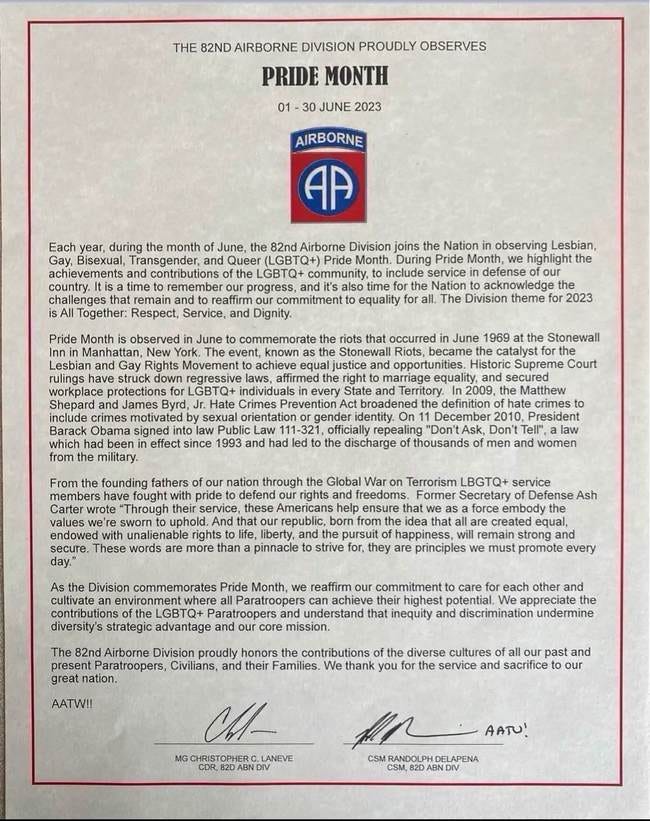
Laneve currently serves as the senior military assistant to the Secretary of War, and is now nominated to become the Army’s Vice Chief of Staff. Thus far, Laneve has not publicly disavowed or distanced himself from the revolutionary viewpoint he recently celebrated.
Similarly, Gen. Kenneth Wilsbach, a staunch advocate for diversity, equity, and inclusion (DEI) initiatives, was nominated by President Trump to become the next Air Force Chief of Staff. Wilsbach consistently prioritized intersectional diversity as a key focus of his management style. Like Laneve, Wilsbach has not publicly repudiated his alignment with critical theory, leaving us no choice but to conclude that he remains committed to these divisive ideologies.
A small number of generals have been shown the door during the second Trump administration, but in subdued fashion. In 2010 Stan McChrystal was the last military general to be publicly relieved by a president. This was over things said about the Obama administration by members of McChrystal’s staff. Far worse has been said of Trump by many across the ranks in open office settings and on social media. It appears that their commanders are generally being left alone, as some generals take it upon themselves to trash their civilian superiors in press reports—the latest example showing up in The Washington Times.
The general calamity of our day is not entirely unique. Consider what Sir. Winston Churchill observed in his essay titled “Mass Effects in Modern Life,” exactly one century ago.
“Instead our Generals are to be found on the day of battle at their desks in their offices fifty or sixty miles from the front, anxiously listening to the trickle of the telephone for all the world as if they were spectators with large holdings when the market is disturbed… No; he is not the hero. He is the manager of a stock market, or a stock yard.”
The current “forever war” has provided ample evidence of the inadequacies of many senior officers. Traditionally, generals were held accountable for battlefield failures, just as CEOs are fired for driving their companies toward bankruptcy. Battlefield failure in our age has paradoxically become a credential for promotion.
But what about character? This is a rare moment in history where we can evaluate the moral integrity and constitutional commitment of our top officers based on their actions during the COVID crisis and their enthusiastic support for DEI initiatives. The question is simple: who among them resisted unlawful orders or refused to cooperate with unconstitutional COVID mandates, DEI policies that violate the Civil Rights Act of 1964, and the ideological assault on conservatives in the ranks? The answer: not one. How many resigned publicly rather than violate their oaths? Again, not one.
Far too many among the officer class openly embraced neo-Marxist doctrines that call for the nation to be decolonized, dismantled, and deconstructed. We must take them at their word where loyalties lay. Not one publicly reversed position, nor offered any explanation for his or her activism in recent years. Even should any among them attempt explanation, excuses of just doing what one had to do in the recent past are never morally-acceptable excuses for military officers. Resisting unlawful orders is foundational to preserving an army of free men rather than reckless mercenaries.
This reality is not lost on top civilian defense officials. Yet they seem hesitant to clean house. Perhaps they are concerned about the difficulties of replacing these senior officers. The solution, however, is simple, just as it was before the corporatization of military talent management in the post-WWII era. Our nation’s top leadership must begin by relieving incompetent officers, retraining or releasing them into civilian life, and promoting real leaders. As always, history offers valuable lessons.
In 1862, President Abraham Lincoln relieved Gen. George McClellan, who had proven a weak battlefield leader and politically antagonistic to his civilian superiors. Lincoln found better leadership by looking outside the traditional military career path. Ulysses S. Grant, for example, went from resigning as a captain in 1854 to being reinstated as a full colonel seven years later, ultimately becoming the only general capable of defeating the formidable Robert E. Lee. Grant would not have had enough time in service to make it to the rank of lieutenant colonel in today’s Army. Likewise, Joshua Lawrence Chamberlain was not far removed from his time as a civilian college professor when commissioned into the Army as a lieutenant colonel and put in command of the 20th Maine Volunteer Infantry Regiment. The academic helped turn likely union defeat at Gettysburg into victory, and went on to become a brigadier general before the Civil War’s end. American military tradition is replete with many such examples in which rank and command followed capability over box checks. Excuses that defend holding on to incapable and politically-hostile senior officers over manning concerns is like asking the gardener not to remove a termite-infested root because you don’t have a bag of dirt on hand to immediately fill the hole. The talent needed to get the job exists for those willing to look beyond the reach of their own arms.
I commend Secretary of War Pete Hegseth’s recent address to military leadership, in which he called for accountability and the reinstatement of basic military standards. But such rhetoric must be followed by decisive action. Uniformed partisans, determined to undermine the will of the voters, do not respond to speeches; they respond to the application of power. The tools exist to deal with these renegades, but the question remains: Is there the will to use them?
America is in a moment that the current Praetorian Guard can be tamed for a generation, and the military reoriented to public service. I ask you, dear reader, to join me in asking our elected leaders and their appointees at the War Department to exercise lawful authority to break up the unaccountable cabal of Pentagon careerists and restore public accountability as a tenet honored both by the public and those who run the armed services. There is a battle for the military’s soul. We must win it to prevent the enemies of ordered liberty from turning the nation’s defenders against us and future generations.
https://redstate.com/chase-spears/2025/10/25/a-general-dilemma-the-war-department-must-remedy-n2195439
Bibliography:
Gudmundsson, Bruce I. Stormtroop Tactics: Innovation in the German Army, 1914–1918. Westport, CT: Praeger, 1989.
Khan, Asad “Genghis.” “Pentagon Bloat: Why We Have Too Many Stars and Not Enough Warriors.” The Sentinel (podcast), October 2025. [Note: As podcasts are not typically archived with stable URLs unless specified, the citation assumes the episode was accessed in October 2025; specific platform or URL unavailable from provided context.]
Lind, William S. Maneuver Warfare Handbook. Boulder, CO: Westview Press, 1985.
Lind, William S., Keith Nightengale, John F. Schmitt, Joseph W. Sutton, and Gary I. Wilson. “The Changing Face of War: Into the Fourth Generation.” Marine Corps Gazette 73, no. 10 (October 1989): 22–26.
Lohmeier, Matthew. Irresistible Revolution: Marxism’s Goal of Conquest & the Unmaking of the American Military. Self-published, 2021.
Spears, Chase. “A General Dilemma the War Department Must Remedy.” RedState, October 25, 2025. https://redstate.com/chase-spears/2025/10/25/a-general-dilemma-the-war-department-must-remedy-n2195439.
Vandergriff, Donald E. Raising the Bar: Creating and Nurturing Adaptability to Deal with the Changing Face of War. Washington, DC: Center for Defense Information, 2006.
Notes on the Bibliography:
Gudmundsson: The citation references the 1989 first edition of Stormtroop Tactics, as it is the standard scholarly work on German military innovation, aligning with the article’s emphasis on bottom-up tactical reform.
Khan: The podcast episode is cited based on the article’s mention of an October 2025 episode. Without a specific URL or platform, the citation follows Chicago’s format for non-archived media, assuming access at the time of publication.
Lind: The Maneuver Warfare Handbook (1985) is cited as the seminal work on maneuver warfare, directly referenced in the preface. The 1989 Marine Corps Gazette article is included as it is explicitly mentioned and foundational to Lind’s fourth-generation warfare concept.
Lohmeier: Irresistible Revolution is cited based on its 2021 self-published edition, as referenced in the preface for its critique of Cultural Marxism in the military.
Spears: The article itself is cited with its full URL and publication details, per Chicago style for online news articles.
Vandergriff: Raising the Bar (2006) is cited as referenced in the preface, published by the Center for Defense Information, focusing on adaptable military cultures.
A great critique of the endemic rot within the senior officer ranks. If Hegseth & Co don't move decisively, I am afraid the GOFO will slow-walk the reform and revert back to their comfort zone.
By March 2026, the Midterm Election cycle will change priorities. If this Administration loses the House Majority, all Trump-Hegseth gains will be parried...and DEI will rise from the ashes - stronger than before.
Nothing but agreement with Colonel Chase.
… as to the Will to act…
The President is a builder and peacemaker, not a destroyer and not a lawbreaker. So far.
If too far he may be doomed.
But we 🇺🇸 aren’t, because he has done the most important thing… he has created thousands of young cadres, far beyond the noble triumvirate mentioned at DoW.
… nor are we lacking in many veterans who quite understand the true nature of “Law.”