Revamping the Military Promotion and Personnel System
The 2026 memos validate my long fight: performance must trump pleasing superiors. Implementing free-play wargames, objective metrics, and Mission Command culture

Vandergriff analysis and proposals to Reform
Stuart Scheller’s April 15, 2023, article “Our Rotten Military Promotion System” incisively diagnoses a core dysfunction in the U.S. military: a promotion system rooted in subjective evaluations that incentivizes careerism and “pleasing the boss” over objective warfighting performance. Drawing from the Kabul Abbey Gate incident (August 2021), where indecision contributed to tragedy, and historical parallels like the 1983 Beirut barracks bombing, Scheller argues that the “up-or-out” system and reliance on officer efficiency reports (OERs/FitReps) prioritize risk aversion and relationships over merit, adaptability, and troop welfare. He calls for performance-based reforms, including wargaming competitions (”free play” pitting leaders against peers in their specialties) to identify and accelerate talent.
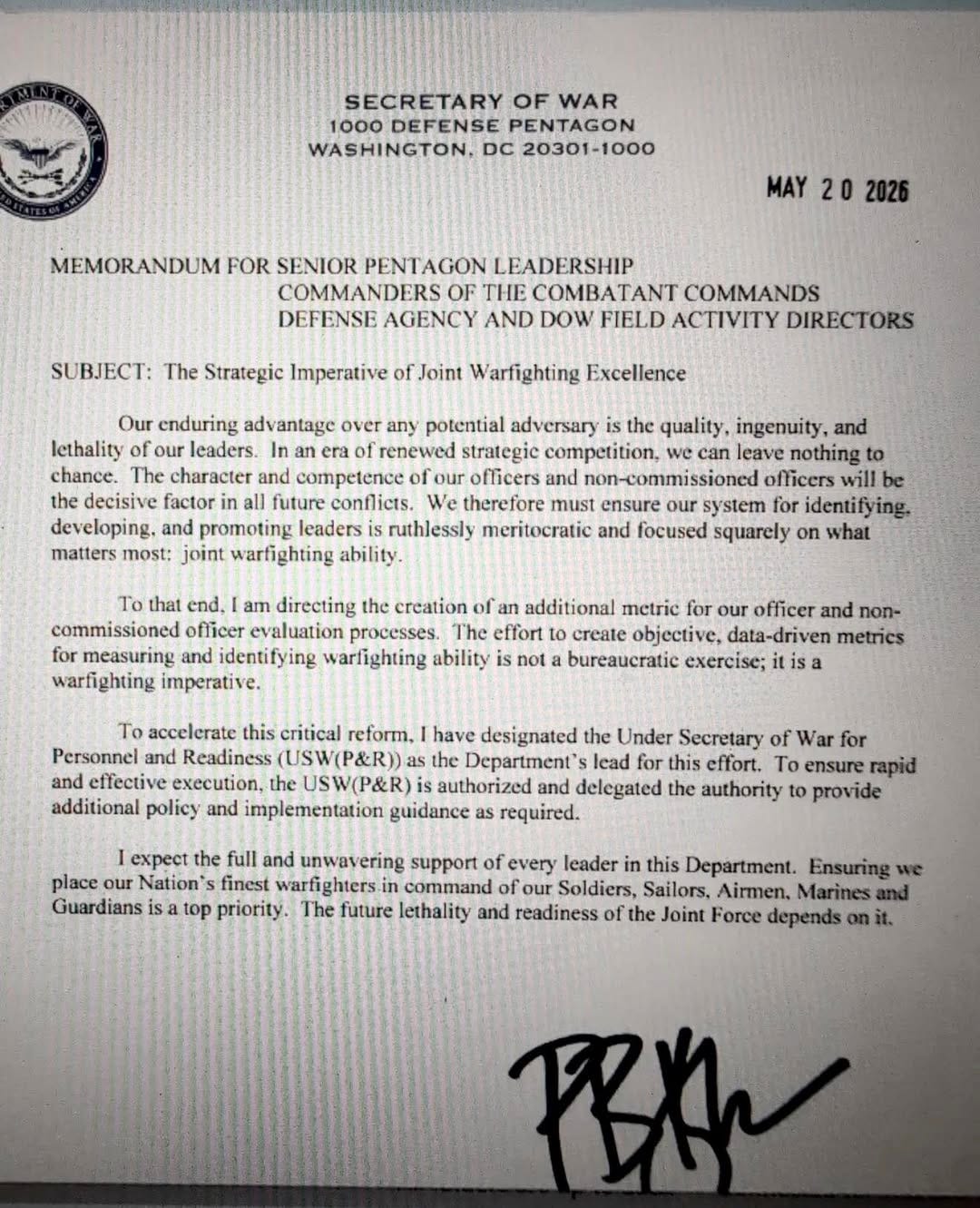
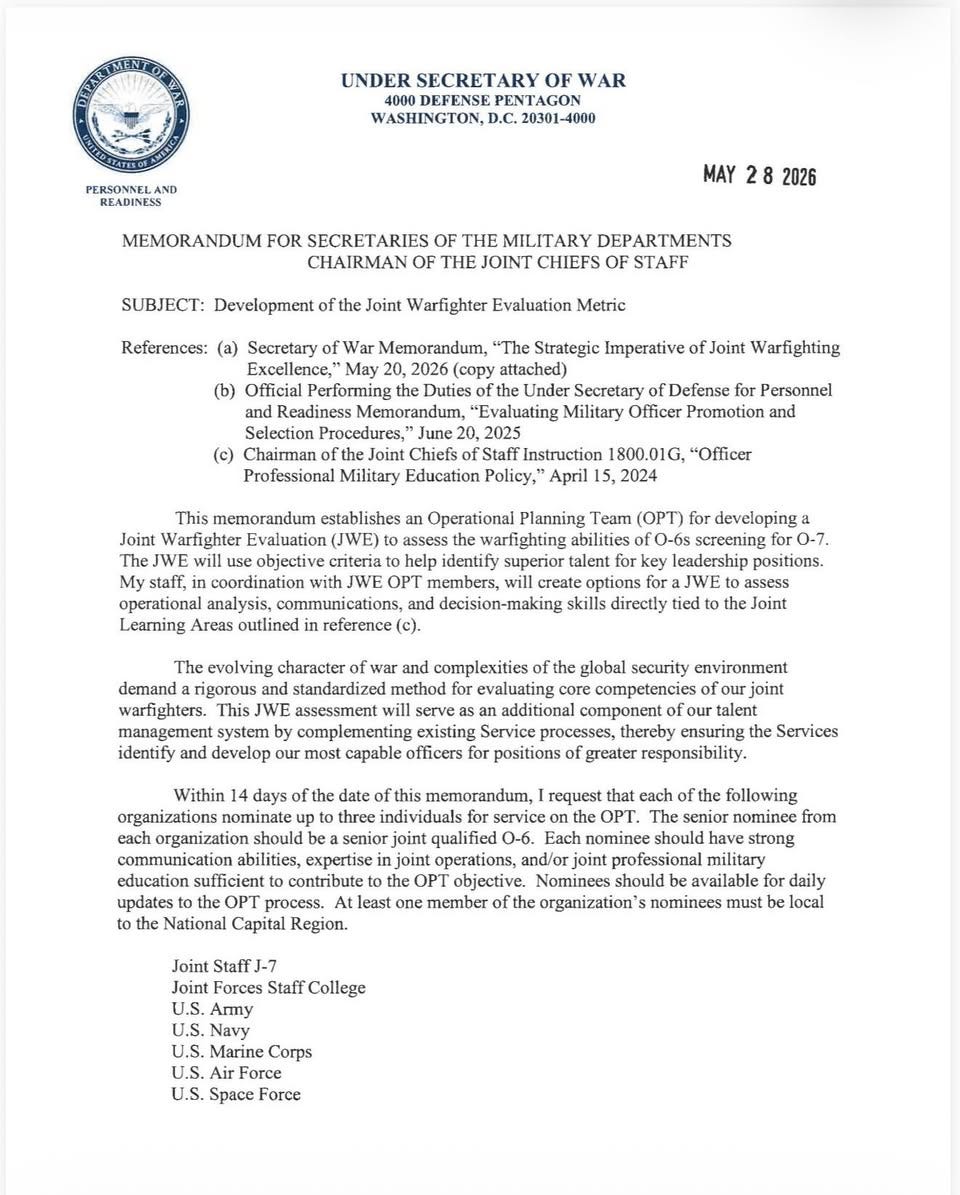
Scheller’s critique aligns precisely with long-standing systemic failures. The recent Department of War memorandums (May 20 and 28, 2026) represent a pivotal step toward addressing these issues, directing the creation of a Joint Warfighter Evaluation (JWE) metric focused on joint warfighting ability, operational analysis, communications, and decision-making. These memos emphasize ruthless meritocracy, data-driven identification of talent for O-6 and above positions, and an Operational Planning Team (OPT) led by Scheller himself as Senior Advisor.
Department of War Memorandums (Top-Left Box for Reference)
Memorandum for Senior Pentagon Leadership (Secretary of War, May 20, 2026):
Directs creation of an additional metric for officer/NCO evaluations centered on joint warfighting ability. Designates the Under Secretary of War for Personnel and Readiness (USW(P&R)) as lead. Stresses that “the character and competence of our officers and non-commissioned officers will be the decisive factor in all future conflicts” and demands a “ruthlessly meritocratic” system.
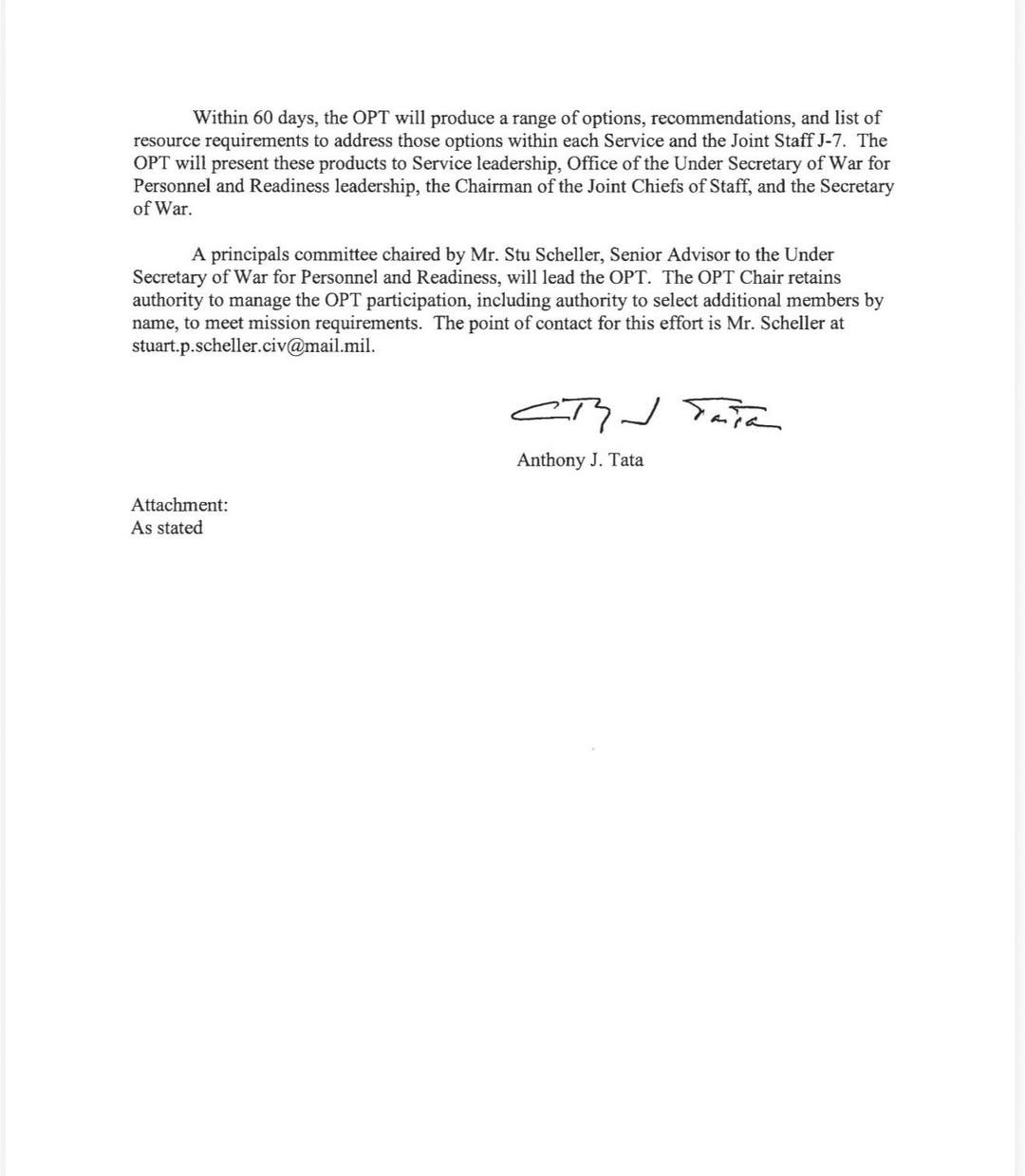
Memorandum for Secretaries of the Military Departments and CJCS (Under Secretary of War, May 28, 2026):
Establishes the OPT for the Joint Warfighter Evaluation (JWE) to assess O-6 screening for O-7. References the May 20 memo and calls for nominations of senior joint-qualified O-6s. The OPT, chaired by Mr. Stu Scheller, will produce options within 60 days. Point of contact: stuart.p.scheller.civ@mail.mil.
These directives echo Scheller’s 2023 call and mark tangible progress under new leadership.
Vandergriff’s Foundational Contributions
I have advocated these exact reforms for decades—predating Scheller’s public critique—through books, articles, workshops, and direct engagement with Pentagon leaders. I have also been on the cover of Army Times, twice, in the Washington Post, and profiled in several professional magazines from 1997-2009. My work on personnel system transformation, adaptive leadership, Outcomes-Based Learning (OBL), Maneuver Warfare, Mission Command (drawing from Prussian Auftragstaktik), and Generations of War (especially 4GW/5GW) provides the intellectual and practical foundation for shifting from an Industrial Age, centralized, attrition-focused bureaucracy to a decentralized, adaptive, performance-oriented system suited to modern hybrid conflicts.
My key insights include:
Replacing “up-or-out” and time-based promotions with merit-based tracks emphasizing demonstrated performance in free-play exercises, wargames, and real-world adaptability.
Dramatic reduction of the officer corps, particularly at the senior levels (see my 2010 Officer Corps Study for Army Capabilities Integration Center (ARCIC)
Cultivating a Mission Command culture where leaders exercise initiative within intent, reducing micromanagement and careerist paralysis.
https://responsiblestatecraft.org/hegseth-personnel-reforms-military/
Aligning personnel systems with Maneuver Warfare principles (speed, surprise, decentralization) and understanding 4GW/5GW threats (internal insurgency, perception management, lawfare).
https://www.pogo.org/investigates/personnel-reform-and-military-effectiveness
Using OBL and rigorous leader development to identify talent early and promote based on results, not seniority or patronage.
https://www.amazon.com/Adopting-Mission-Command-Developing-Superior/dp/1682471055

In direct response to Scheller’s April 30, 2025, social media call for ideas on combating careerism, I published Substack analyses (May 2025) outlining a personnel system for Maneuver Warfare and Mission Command. I followed with further responses in June 2025 and an August 2025 analysis of Scheller’s general officer reform proposals, including a “Merit-Based Track Promotion (MBTP)” system and “DC Time Cap” to curb bureaucracy.
These build on my earlier works, such as proposals for overlapping reforms in Path to Victory and presentations to senior leaders advocating wargame-based screening—ideas now reflected in the 2026 JWE metric.
The 2026 memos validate my long fight: performance must trump pleasing superiors. Implementing free-play wargames, objective metrics, and Mission Command culture will empower decisive leaders, as Scheller and I both urge, ensuring the Joint Force prioritizes lethality over career progression.
Endnotes
Stuart Scheller, “Our Rotten Military Promotion System,” April 15, 2023. See also Scheller, Crisis of Command: How We Lost Trust and Confidence in America’s Generals and Politicians (2022).
Secretary of War, “The Strategic Imperative of Joint Warfighting Excellence,” Memorandum, May 20, 2026; Under Secretary of War, “Development of the Joint Warfighter Evaluation Metric,” Memorandum, May 28, 2026.
Donald E. Vandergriff, Adopting Mission Command: Developing Leaders for a Superior Command Culture (Annapolis, MD: Naval Institute Press, 2019). Vandergriff traces Auftragstaktik and its application to U.S. forces.
Donald E. Vandergriff, “Answering SES Stuart Scheller’s First Question in Social Media about Combating Careerism,” Substack, May 2, 2025; “My Analysis of Stuart Scheller’s Proposal for General Officer Reform,” Substack, August 19, 2025.
Donald E. Vandergriff, The Path to Victory: America’s Army and the Revolution in Human Affairs (2002); contributions to Mission Command anthologies (ed. with Stephen Webber); numerous articles on 4GW/5GW, including in Reforging the Sword series and The Internal Insurgency (with forward by Martin Sieff). See also Vandergriff’s Substack (donvandergriff.substack.com) and works on OBL/ASLTE programs.
For broader context: William S. Lind on Maneuver Warfare and Generations of War; Vandergriff’s integration in leader development programs for Army, NATO, and law enforcement.
Begin Stuart Scheller’s Article
Our Rotten Military Promotion System
By Stuart Scheller
April 15, 2023
A Marine sniper serving during the Afghanistan evacuation recently gave testimony to the House Foreign Affairs Committee on the Afghanistan evacuation. His pain was palpable. A revelation worth examining was his identification of the possible suicide bomber prior to the incident. After the sniper, Sgt Vargas-Andrews, confirmed the target with multiple agencies, he asked his Battalion Commander, LtCol Whited, for permission to shoot. The answer from Whited, one in which Vargas-Andrews said he’ll never forget, was, “I don’t know.”
Not found in the media or Congressional testimony is that Whited, a former peer of mine, corroborated this version of events in his formal statement for the military’s investigation. When speaking to the investigating officer, General Curtis, on 5 October 2021, Whited stated, “[We had] a description of a person of interest. We watched him for hours… It bothers me still that we lost track of him, and never heard anything back from higher about him.”
The obvious indecision in Kabul on 26 August 2021 has a much deeper undercurrent. Since World War II, the American military promotion system hasn’t evolved with the needs of today’s challenging security environment. Current military professionals are conditioned, above all else, to please superiors for continued advancement. Said another way, when promotion is the mission, it will always be more important than troop welfare. “I don’t know” is another way of saying, “The risk to force isn’t as great as the risk to my career.”
This understanding leads to an obvious question: Can the military incentivize performance over career progression?
Predictably, without changes to the military system, the lessons of the past will consistently need to be re-learned. In some depressing ways, the Afghanistan evacuation was executed incrementally better than the 1983 Beirut operation; Vargas-Andrews at least had bullets in his gun. The Marines standing post in Beirut weren’t allowed to insert magazines into their weapons. Those Marines were forced to watch a vehicle IED drive past their security post and kill 220 Marines. General officers from the Beirut incident later testified to Congress that negligent discharges into the city were more of a risk than providing Marines on post the lethal force required for protection.
Unfortunately, like the unnecessary loss of life during the Afghanistan evacuation, general officers following the 1983 Beirut incident were also absolved of responsibility. In fact, General Alford Gray, who commanded the division of the attacked Marine unit, later went on to become the Commandant of the Marine Corps. Similarly, General Farrell Sullivan, the officer who LtCol Whited “never heard back from,” was promoted in billet upon his return the states. Despite General Berger, the Commandant of the Marine Corps, stating on 1 September 2021 that he wanted an “honest, open critique, or a commission… that cracks open the options available [for the Afghanistan evacuation,]” an internal military panel never materialized. This may be for many reasons. Yet an objective analysis must acknowledge that General Farrell Sullivan, who both the sniper and battalion commander waited on for engagement approval, also previously served as the battalion executive officer in 2002 while General Berger commanded 3/8. Again, never underestimate the importance of relationships and pleasing a boss in the antiquated military system.
Compounding the general officer’s inability to hold themselves accountable, Congress, enamored of the military officer, also fails to provide accountability even after listening to long lists of inexcusable mistakes. While Congress controls the DoD budget, they demonstrate an unwillingness to use the budget as a tool for influence. Why? Asking tough questions is less risky than being painted as ‘anti-military’ for standing in the way of the DoD budget. In other words, there are fewer risks to career advancement within the current model. Sound familiar?
It is also worth noting that most Americans apolitically believe President Biden mishandled the Afghanistan evacuation. But most Republicans only selectively remember President Reagan strengthening the military. President Reagan made the decision to send Marines to Beirut, and Reagan, much like Biden, was too afraid to hold senior military leaders accountable for their failures.
A commander in chief is unlikely to fire a general for military failure if it reflects poorly on the president’s decision making. If the lists from the 1983 Beirut operation, the Afghanistan evacuation, and the numerous other in-between examples aren’t enough to justify the relief of a general officer, self-serving incentives dictate that military officers should consistently default towards career protecting decisions.
The underlying reason for this “I don’t know” or “I was just following the orders I was given” culture is the current promotion system. In every branch of service, officer promotions are based solely on subjective evaluations from a boss. While most people want to believe that military commanders evaluate subordinates based strictly on occupational performance, anyone who has served knows that impressing a boss for a top evaluation requires substantially more finesse than job performance. Military professionals are hyper aware that during some critical billets, it only takes one bad evaluation to end a career. Thus, the secret to a military career is more about pleasing a boss, than demonstrating objective performance.
The House Armed Forces Committee renewed investigation into the Afghanistan evacuation may continue illustrating shortfalls by senior military leaders. But without a mechanism to change the culture of the military, current people-pleasing incentives will ultimately dictate the future actions of military professionals.
I believe the military must move to a performance-based promotion system now. Americans can no longer afford the unnecessary loss of life of their sons and daughters based on antiquated systemic career progression incentives. The next Secretary of Defense should make this a focus above all other initiatives. A boss’s assessment may be a factor in promotion, but occupational performance must be more important.
The military should develop warfighting games pitting leaders against each other. Make it truly free play. F-16 pilot against F-16 pilot, infantry officer against infantry officer, logistician against logistician, and so on. The winner must demonstrate performance through action, not assessment through the eyes of a boss. The winner receives preferential treatment for promotion. Furthermore, the next Secretary of Defense must be more aggressive in building a system of incentives for promotion based on performance, not time. Any military member should be able to ‘try out’ for higher ranks during the wargame competition. Move talented leaders up more quickly. This will do more for retaining talent than all other initiatives.
If the military builds a true performance-based system, it is more likely the leaders of the organization will be empowered by their judgment than by the assessments and opinions of their superiors. Hopefully, the next Sgt Vargas-Andrews never receives the answer, “I don’t know.” Performers make decisions. People pleasers and rule followers wait for the answer from a superior.
Can the military incentivize performance over career progression? I believe it can, but leadership must fundamentally change the system of incentives prioritizing career progression over junior service member’s sacrifices. This starts with new leadership demonstrating the same courage expected from the troops on the ground.
Stuart Scheller is a former LtCol, USMC and author of Crisis of Command: How We Lost Trust and Confidence in America’s Generals and Politicians
Outstanding Sir, we need a hell of a lot more Pattons and Pullers, IMHO, Semper Fi Brother!!!