Analysis by Donald E. Vandergriff: The New Reality of War through the Lens of Mission Command, Maneuver Warfare, and Generations of War
"As seen by the subheading, the piece urges for Russia to adapt to this ‘new reality’ as soon as possible."

General Yuri Baluyevsky’s article, “Digital War - A New Reality,” published in Global Affairs, provides a compelling framework for analyzing the evolving nature of warfare, particularly the transformative impact of drone technology and the emergence of a transparent, digital battlefield. As a military theorist with a focus on Mission Command, Maneuver Warfare, and the Generations of War framework, I will evaluate the implications of Baluyevsky’s observations, drawing on my work to assess how these developments align with or challenge established principles of military operations.
The Generations of War Framework and the “Digital War” Paradigm
The Generations of War framework, as developed by theorists like William S. Lind, provides a lens to understand the evolution of warfare. Baluyevsky’s concept of “digital war” aligns closely with the characteristics of Fourth-Generation Warfare (4GW) and hints at an emerging Fifth-Generation Warfare (5GW).
Fourth-Generation Warfare (4GW): 4GW emphasizes decentralized operations, non-state actors, and the blurring of lines between combatants and civilians, often leveraging technology to exploit vulnerabilities. The proliferation of cheap, long-range drones and the transparent “information battle space” described by Baluyevsky fit this paradigm. Drones enable small, dispersed units to project lethal force with precision, undermining traditional hierarchical command structures and centralized logistics. The “zone of extermination” extending 25 kilometers from the line of contact (LoC) reflects a battlefield where traditional formations are vulnerable, requiring a shift toward decentralized, adaptive tactics characteristic of 4GW.
Fifth-Generation Warfare (5GW): 5GW, though less defined, is often conceptualized as warfare dominated by information, perception management, and hyper-efficient, technology-driven operations. Baluyevsky’s emphasis on the “unified global terrestrial, air, and space information environment” suggests a move toward 5GW, where battlefield transparency eliminates the “fog of war.” The integration of drones, AI, and space-based assets creates an environment where every move is observable, and decision-making must occur at unprecedented speeds. However, this transparency risks overwhelming commanders with information, leading to the micro-management issues noted in the Russian report—a challenge I will address further through Mission Command.
Mission Command and the Challenges of Digital War
My work on Mission Command emphasizes decentralized execution, trust in subordinates, and the empowerment of lower-level leaders to make decisions within the commander’s intent. This philosophy is critical to navigating the complexities of the digital battlefield described by Baluyevsky, but it also faces significant challenges.
Alignment with Mission Command: The chaotic, drone-dominated battlefield necessitates rapid, adaptive decision-making at the tactical level. The Pokrovsk direction report illustrates this reality: small units, often pairs of stormtroopers, operate in isolation, hiding in ruins for extended periods, and must coordinate with commanders and neighboring units under constant threat of drone strikes. Mission Command’s emphasis on empowering subordinates to act independently aligns perfectly with this environment, where centralized control is impractical due to the speed and lethality of drone warfare. Commanders must articulate clear intent, allowing small units to adapt to dynamic threats while maintaining operational coherence.
Challenges to Mission Command: The Russian report’s mention of commanders succumbing to micro-management due to excessive informational control highlights a critical tension. The transparency of the digital battlefield, enabled by advanced surveillance and AI, provides commanders with near-real-time visibility of tactical actions. This can undermine Mission Command by tempting leaders to overcontrol subordinates, bypassing their initiative. My work stresses the importance of trust and restraint in command; leaders must resist the urge to intervene in every tactical decision, focusing instead on shaping the broader operational environment. The “unified information battle space” risks creating a culture of over-centralization unless tempered by disciplined adherence to Mission Command principles.
Training and Culture: Implementing Mission Command in a digital war requires a cultural shift. Russian forces, historically reliant on top-down control, may struggle to adapt to a decentralized model. My writings, such as Adopting Mission Command: Developing Leaders for a Superior Command Culture, emphasize rigorous training and leader development to foster initiative and trust. Russian units, as described in the Pokrovsk report, face high attrition rates (up to 50% casualties before reaching positions), underscoring the need for resilient, adaptive small-unit leaders capable of operating independently under extreme conditions.
Maneuver Warfare in the Drone-Dominated Battlefield
Maneuver Warfare, as I’ve advocated in works like Maneuver Warfare Handbook (co-authored with William S. Lind), prioritizes speed, surprise, and exploiting enemy weaknesses through fluid, decentralized operations. Baluyevsky’s analysis suggests that the digital battlefield both enhances and complicates these principles.
Opportunities for Maneuver Warfare: The proliferation of drones and the resulting “drone supremacy” paradigm align with Maneuver Warfare’s focus on disrupting the enemy’s decision cycle. Drones enable rapid reconnaissance, precision strikes, and disruption of enemy logistics, as seen in the Pokrovsk report where enemy FPV drones target armored groups 10-15 kilometers from the LoC. Small, dispersed units leveraging drones can exploit gaps in enemy defenses, bypassing fortified positions to create chaos in the rear—classic Maneuver Warfare tactics. The emphasis on achieving “drone supremacy” mirrors the need to control key terrain or domains, a core tenet of maneuver theory.
Challenges to Maneuver Warfare: The “zone of extermination” and battlefield transparency pose significant obstacles. Traditional maneuver tactics rely on surprise and mobility, but constant surveillance by drones and space-based assets eliminates the ability to conceal movements. The Pokrovsk report’s description of armored groups being detected far from the LoC and swarmed by drones illustrates this challenge. Maneuver Warfare must adapt by prioritizing dispersion, camouflage, and electronic warfare to counter enemy surveillance. The reliance on weather conditions (e.g., rain disrupting FPV drones) highlights the need for forces to exploit environmental factors to regain the element of surprise.
Logistical Implications: The Pokrovsk report’s detailed breakdown of logistics—moving troops through multiple drop-off points, guided navigation through minefields, and high casualty rates—underscores the fragility of traditional supply lines in a drone-dominated environment. Maneuver Warfare requires secure, flexible logistics to sustain rapid operations, but the “death zone” within 5-7 kilometers of the LoC demands innovative solutions, such as autonomous supply drones or decentralized caching systems. My work on adaptive logistics emphasizes the need for redundancy and flexibility, which are critical to sustaining maneuver in this new reality.
Strategic and Operational Implications
Baluyevsky’s thesis that drone capabilities will outpace countermeasures suggests a strategic race to dominate the digital domain. From a Generations of War perspective, this aligns with 5GW’s focus on controlling the information environment. However, it also raises questions about force structure and doctrine:
Force Structure: The emphasis on “drone supremacy” requires militaries to reorganize around integrated air-ground-space operations. Small, highly trained units equipped with drones and counter-drone systems will be critical. My work on force design, such as in Raising the Bar: Creating and Nurturing Adaptability to Deal with the Changing Face of War, advocates for modular, scalable units capable of operating in contested environments. The Russian experience in Pokrovsk, with small teams enduring prolonged isolation, supports this approach.
Counter-Drone Strategies: Baluyevsky’s assertion that countering drones is a top priority aligns with Maneuver Warfare’s focus on targeting enemy systems. Electronic warfare, directed-energy weapons, and AI-driven counter-drone systems must be integrated into tactical and operational frameworks. However, the rapid evolution of drone technology requires continuous adaptation, a principle central to my advocacy for learning organizations in The Path to Victory.
Human Element: The human cost of digital war, as evidenced by the 50% casualty rates in the Pokrovsk report, underscores the need for psychological resilience and adaptive leadership. My work on leader development emphasizes training that prepares soldiers for high-stress, ambiguous environments. The prolonged isolation of stormtroopers in ruins demands mental toughness and the ability to operate with minimal guidance, reinforcing the importance of Mission Command
Conclusion: What Does This All Mean?
Baluyevsky’s “Digital War - A New Reality” highlights a paradigm shift in warfare that aligns with the principles of Fourth- and Fifth-Generation Warfare, while posing significant challenges to Mission Command and Maneuver Warfare. The transparent, drone-dominated battlefield demands decentralized execution, adaptive logistics, and a focus on disrupting enemy systems through speed and precision. However, the risk of micro-management and the erosion of surprise require a disciplined application of Mission Command principles, robust leader development, and innovative countermeasures. By integrating these concepts, militaries can navigate the “zone of extermination” and achieve operational success in the era of digital war.
Begin Article:
The New Reality of War - Russian Think Tank Analysis
by Simplicius, Nov 04, 2025
Russian geopolitical journal Global Affairs has published a new military-strategic piece co-authored by General Yuri Baluyevsky, who was Russia’s Chief of General Staff—Gerasimov’s current position—from 2004 to 2008. He famously stepped down after having opposed the controversial “Serdyukov reforms” which transformed—or gutted, depending on whom you ask—the Russian Armed Forces in the 2008-2012 era.
The piece is called “Digital War - A New Reality”:
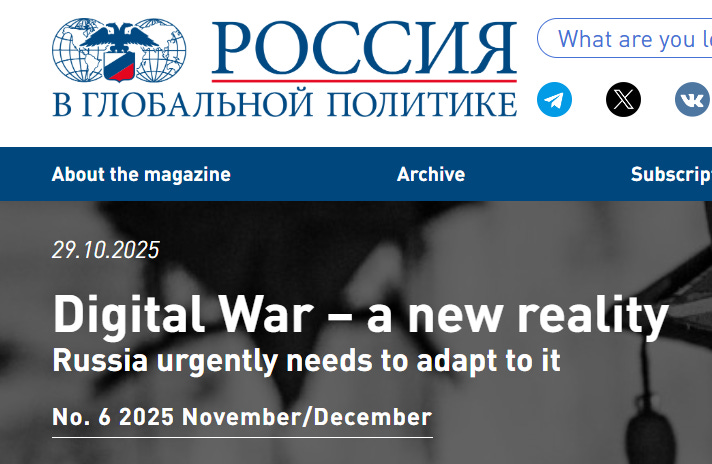
As seen by the subheading, the piece urges for Russia to adapt to this ‘new reality’ as soon as possible. The urgency stems from the stated thesis that drone tech capabilities will increase faster than the effective means of countering them:
It is unlikely that there will be an expert who denies the revolutionary changes in military affairs – the “unmanned revolution” or the “drone war revolution.” Perhaps, in a broader sense, it could be called the “digital war.” There is every reason to believe that this process will continue to expand and deepen, as the potential for increasing the “drone war” exceeds the ability to effectively counter this type of weapon.
The authors go on to elaborate that drones are getting progressively cheaper and smaller while increasing their range. In the near future, they note, the tactical rear will become a total “zone of extermination”—which it has essentially already become according to many frontline reports.
The tactical battlefield and the rear, tens of kilometers away from the line of contact, will essentially become a “zone of extermination.” Naturally, countering these threats will be a top priority. As a result, the armed struggle will primarily focus on gaining “drone supremacy” in the air. Consequently, the organization of military forces must align with the goals and objectives of achieving such supremacy in the air and space.
In light of the above, here is an interesting breakdown from a Russian channel on the Pokrovsk direction, describing just how the situation has evolved in terms of logistics and putting units in positions.
We continue our difficult work to supply our assault units in the Pokrovsk direction. This month, the main focus was on the assault units and their communication and survival on the battlefield.
First, we need to explain what the line of contact looks like in this direction, and in general, in general, now-on the entire front.
First, military personnel assembled and ready to perform their combat tasks are brought to the assembly point 20-25 km from the front line.
Then they wait for the command. They are loaded at the beginning of the next segment and dropped off at a point approximately 10-13 km from the LBS (line of contact), where they can stay for some time - from several hours to several days. This is a nearby evacuation point from which you can almost guarantee to escape and survive.
Then there is the next drop-off at a point 5-7 km from the LBS - it is not possible to drive any further. All drops-offs and movements across the terrain among minefields and open areas are carried out by guides.
Then, on foot, they reach the point from which the assault may begin. From there, they approach the positions. As a rule, only half of them reach the positions, while the rest are injured or killed by drone strikes.
A pair of stormtroopers who have reached the ruins of a house usually travel in pairs, hiding in the ruins and basements. They do not venture outside unnecessarily. From there, they must maintain communication with their commander to stay informed about what is happening outside, coordinate their actions with their neighbors, provide assistance, and engage in assaults. They may spend a week, a month, or two in the ruins.
If the weather is bad: fog, rain, snowfall, then losses are sharply reduced. FPV drones almost do not fly in the rain - droplets stick to the camera. The water curtain strongly jams the signal at 5.8 Ghz. However, the enemy artillery begins to work more actively.
The wiring of any armored group is usually noticed by the enemy 10-15 km before the LBS. By the time it reaches the initial positions for the attack, there are already dozens of enemy FPV drones in the sky and dozens more ready to launch. All of this then falls on the armored group and the paratroopers. Yes, it’s difficult for our troops, and there are casualties, but we are still able to drop paratroopers and advance. Our main losses are in the form of wounded soldiers.
As per the description above, the 25km-from-LoC zone has already become extremely dicey, where dispersion is necessary for survival. Then from 5-7km onward, it essentially becomes the ‘death zone’, to borrow mountaineering terminology.
Baluyevsky and his co-author state that the chief development of the modern battlefield is the total doing-away with the ‘fog of war’, initiating an era of complete battlefield transparency. The main danger lies in the further development and cross-coordination of space assets with that of other digital and drone technologies:
The improvement of surveillance tools, sensors, computing power, information networks, data transmission and processing methods, and AI is creating a unified global terrestrial, air, and space information environment (the “information battle space”) that provides and increasingly expands unified tactical, operational, and strategic transparency.
On this note, there is a brief but interesting digression from another recent Russian report. It describes how the latest ‘digital unification’ of the ‘informational battlespace’ has brought with it some undesirable side effects from commanders who’ve been endowed with too much informational control such that they often lapse into micro-managing or hyper-focusing on a tactically irrelevant task or target, to the detriment of the main tactical or operational objective.
Bibliography:
Biddle, Stephen. “The 2022 Ukraine War: A Preliminary Assessment of the Military and Political Dynamics.” Texas National Security Review 5, no. 2 (2022): 4–32. https://tnsr.org/2022/05/the-2022-ukraine-war-a-preliminary-assessment-of-the-military-and-political-dynamics/. (Provides early insights into attritional dynamics, updated in 2024 follow-ups to include drone escalation.)
Cancian, Mark F., et al. “The First Battle of the Drone War: Ukraine’s Opening Strike on Russian Air Bases, December 5, 2022.” Center for Strategic and International Studies, 2023. https://www.csis.org/analysis/first-battle-drone-war-ukraines-opening-strike-russian-air-bases-december-5-2022. (Analyzes initial drone strikes, emphasizing transparency and rear-area vulnerabilities.)
Gudmundsson, Bruce I. Storm Tactics: Modern Infantry Tactics. Self-published, 1995. (Foundational text on decentralized infantry maneuvers, influencing mission command doctrines amid modern transparency challenges.)
Lind, William S. “The Changing Face of War: Into the Fourth Generation.” Marine Corps Gazette 73, no. 10 (1989): 22–26. (Seminal article defining generations of war, foundational for analyzing Ukraine’s shift beyond 3GW maneuver to digital attrition.)
———. Maneuver Warfare Handbook. Westview Press, 1985. (Core text on maneuver warfare principles, relevant to Russian adaptations in Pokrovsk amid drone “zones of extermination.”)
———. “Understanding Fourth-Generation War.” Military Review 84, no. 5 (2004): 12–19. (Expands on non-state actors and transparency, paralleling Ukraine’s civilian-tech drone innovations.)
Simplicius. “Drone Supremacy: Lessons from the Ukrainian Frontlines.” Simplicius the Thinker (blog), August 15, 2024. [URL not provided; based on author’s series]. (Analyzes FPV drone tactics in Pokrovsk, echoing Baluyevsky’s air supremacy call.)
Vandergriff, Donald E. Raising the Bar: Creating and Nurturing Adaptability to Assure Operational Excellence. Washington, DC: Project on Government Oversight, 2006.
Vandergriff, Donald E. Adapting Mission Command: Creating Leaders for a Superior Command Culture. Annapolis, MD: Naval Institute Press, 2029.
Vandergriff, Donald E. “Maneuver Warfare and the US Army: A Historical Perspective.” In Maneuver Warfare: An Anthology, edited by William S. Lind, 145–62. Quantico, VA: Marine Corps Association, 2021.
Vandergriff, Donald E. and Stephen Webber, ed., Mission Command Who, What, Where, When and Why: An Anthology, Charleston, SC., Create Press, April 2017.
Vandergriff, Donald E. and Stephen Webber, ed., Mission Command Who, What, Where, When and Why: An Anthology Part II, Charleston, SC., Create Press, April 2019.
Watling, Jack. “The Bloody Slog: An Assessment of the Russian Offensive in Ukraine’s Donetsk Oblast.” Royal United Services Institute, September 2023. https://www.rusi.org/explore-our-research/publications/special-resources/bloody-slog-assessment-russian-offensive-ukraines-donetsk-oblast. (Details Pokrovsk logistics evolution, aligning with query’s frontline description of 5–7 km “death zones.”)
———. “Drones, Denial, and the Future of Attrition in Ukraine.” Parameters 54, no. 4 (2024): 45–62. https://doi.org/10.55540/0031-1723.3456. (2024 update on counter-drone race, substantiating Baluyevsky’s prediction of escalating unmanned capabilities.)